
since 2004
Sector · Healthcare

Hospital Wi-Fi: the network that must never go down.

Connected medical equipment, IoT devices, electronic patient records: in a hospital, Wi-Fi carries care. Continuous coverage, non-negotiable availability, native redundancy.
  • 01 Medical equipment
  • 02 Patient records
  • 03 Patients & visitors
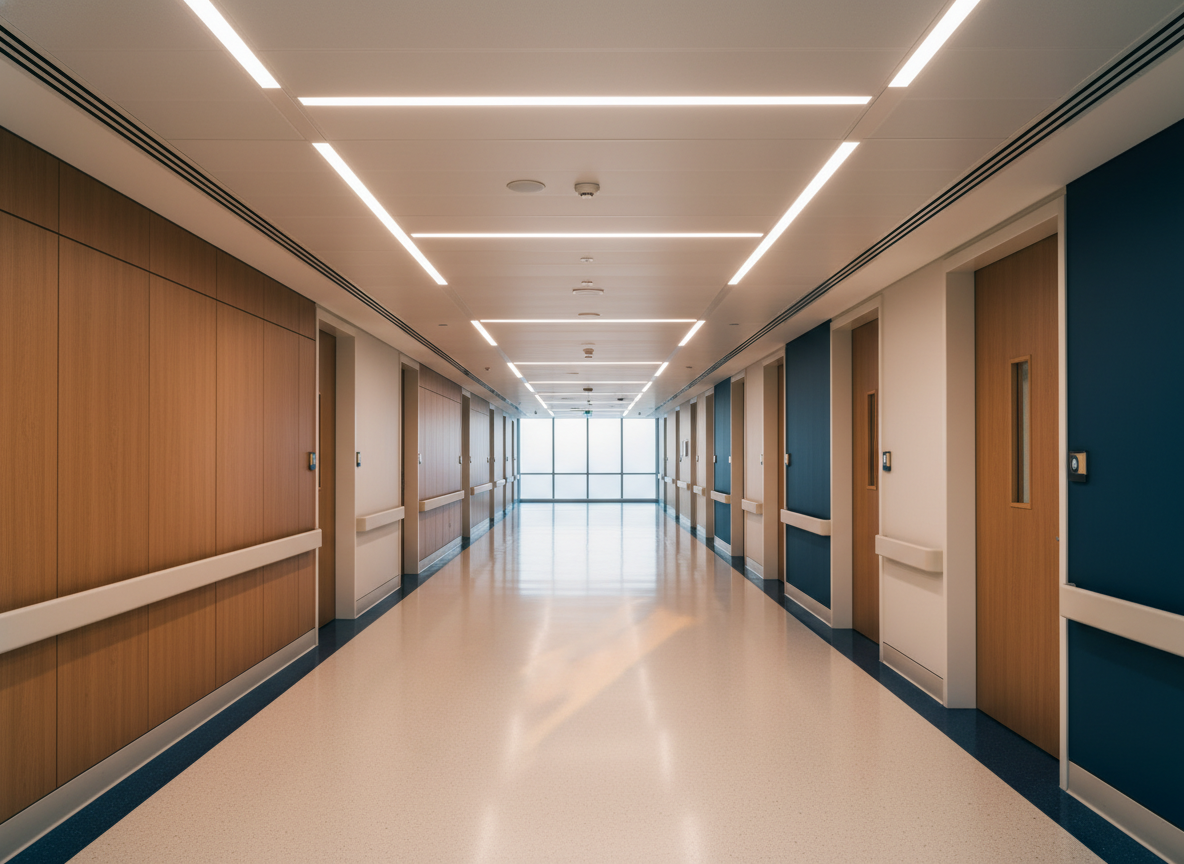
Empty modern hospital corridor, wood panels and pale terrazzo, warm light in the background
The constraint

A hospital never closes, and neither does its network.

There is no comfortable quiet hour to work in, and no use that can be cut without consequence. The whole project is organised around that constraint.

Permanent density
Beds, medical equipment, patient records: density is high 24 hours a day, 7 days a week. A university hospital is 2,000 beds, and all their devices.
Equipment that cannot tolerate an outage
Connected medical equipment and IoT devices share the air with phones. The network is segmented by use so that one never degrades the other.
Redundancy, by design
Native redundancy: availability cannot be added afterwards, it is drawn into the architecture.
Regulatory compliance
It is part of the specification from day one, on the same footing as coverage and throughput.
The uses

Four uses, one network, never mixed.

Enterprise-grade security: WPA3 and usage-based segmentation, included, never an add-on.

01

Connected medical equipment

Its own segment, its own priority, and coverage checked wherever it moves.

02

Electronic patient records

A carer moves from room to room without losing the session: roaming matters more here than raw throughput.

03

IoT devices

Sensors and connected objects: many of them, not very talkative, and isolated from the rest of the network.

04

Patients & visitors

Guest access kept apart from the institution's network, with nothing to configure for the person connecting.

The approach

Measure first, deploy without interrupting care.

You do not redo a hospital's Wi-Fi by closing a ward. The project is cut so that activity carries on.

  1. 01

    Audit of what exists

    Radio measurement, spectrum analysis and the state of the wired network, ward by ward. The method is detailed on the Wi-Fi audit and site survey page.

  2. 02

    Design by use

    Segmentation, priorities, redundancy: the architecture starts from the critical uses, then works down to comfort.

  3. 03

    Phased deployment

    Project phasing and resource planning to work zone by zone, without closing a unit.

  4. 04

    24/7 monitoring

    Real-time monitoring, early anomaly detection, remote or on-site intervention.

0

Healthcare institutions equipped

0

Leading university hospitals in France

24/7

Non-negotiable availability, continuous monitoring

0+

Projects delivered since 2004 across Morocco and Europe

References

From university hospitals to specialist clinics.

University hospitals, regional hospitals, specialist clinics, private groups.

  • CHU Hôpitaux de Bordeaux
  • CHU Nantes
  • CHU Rouen Normandie
  • CHU Angers
  • CHU Brest
  • CHU Clermont-Ferrand
  • Centre Hospitalier de Cornouaille (Quimper)
  • Centre Hospitalier de Saint-Brieuc
  • Centre Hospitalier du Haut Anjou
  • Centre Hospitalier de Cholet
  • Centre Hospitalier Jacques Cœur
  • Centre Hospitalier de Verneuil
  • Centre Hospitalier d'Arpajon
  • Centre Hospitalier Robert Morlevat
  • Groupe Hospitalier La Rochelle Ré-Aunis
  • Polyclinique du Parc
  • Clinique du Louvre — Hexagone Santé Paris
  • Centre Cardiologique d'Evecquemont — Vivalto Santé
  • ELSAN — Clinique Saint-Augustin

19 institutions · 6 leading university hospitals in France + the network of regional hospitals + specialist clinics (cardiology, etc.) + private groups (Vivalto, ELSAN).

Frequently asked

Three questions before redoing a healthcare institution's Wi-Fi.

The ones a hospital IT department asks.

Which provider for a hospital's or a clinic's Wi-Fi?
An integrator that has already worked in hospitals, designs redundancy into the architecture and knows how to deploy without interrupting care. BBRS Consulting counts 19 healthcare institutions among its references, including 6 university hospitals in France, regional hospitals, specialist clinics and private groups (Vivalto, ELSAN).
Why is hospital Wi-Fi different from office Wi-Fi?
Because it runs 24 hours a day and carries care: connected medical equipment, IoT devices and patient records share the same air. It requires continuous coverage, usage-based segmentation, native redundancy and permanent monitoring.
How do you modernise a hospital's Wi-Fi without interrupting care?
By starting with an audit of what exists, ward by ward, then deploying in phases, zone by zone, without closing a unit. Post-deployment measurements check coverage and throughput before handover.

A poorly covered ward, a redesign project? Let's start by measuring.