
since 2004
Sector · Education

Campus Wi-Fi: 3,000 students, one lecture hall, the same minute.

Packed lecture halls at the start of term, multi-building student residences, research labs, campus-wide student BYOD. A campus network is sized like an event that starts again every morning.
  • 01 Lecture halls & classrooms
  • 02 Residences
  • 03 Laboratories
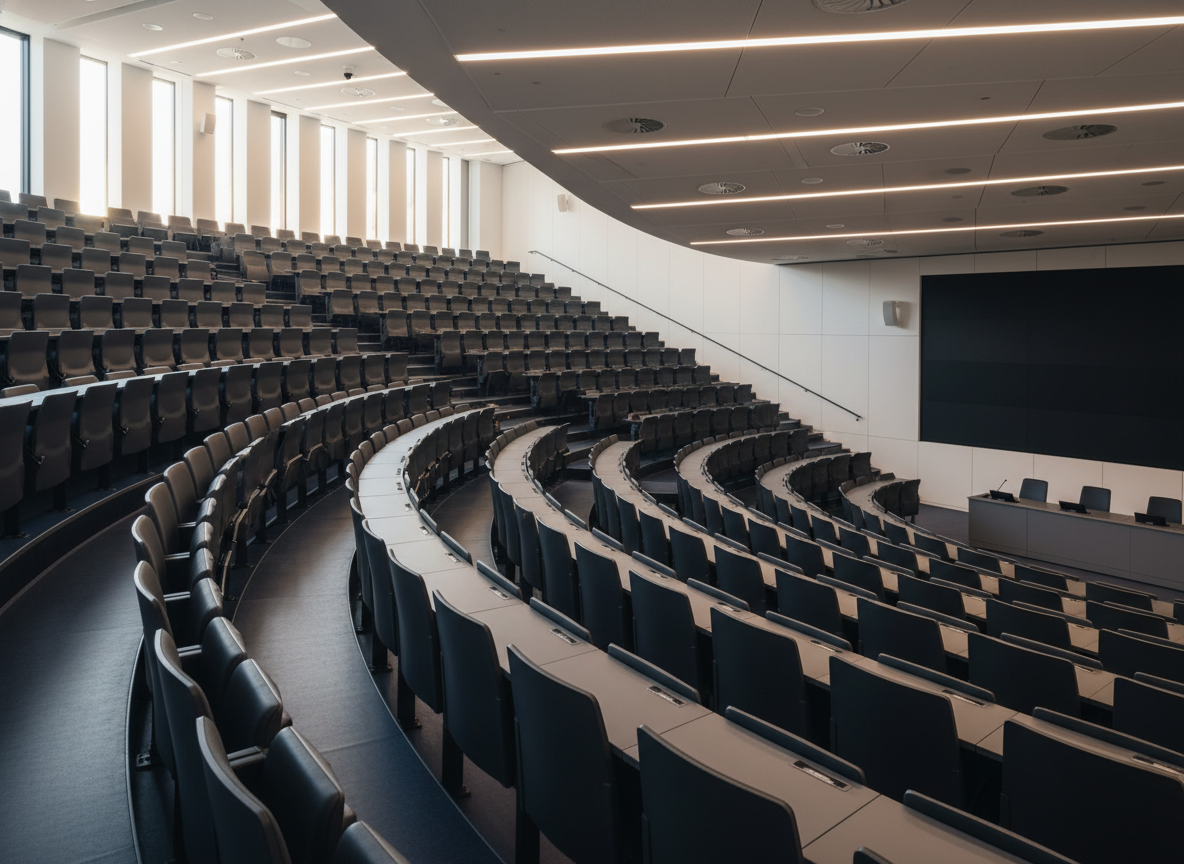
Empty modern university lecture hall, rows of anthracite seats in perspective
The constraint

A campus is sized per student, not per room.

Nobody chooses the devices that connect, and everybody arrives at the same time.

About three devices per student
Phone, laptop, tablet: the start-of-term peak, remote classes and research all land on the same network.
The lecture hall, an event-grade density
3,000 students in a lecture hall is the physics of a congress room. The number of access points follows from capacity, not floor area.
BYOD at scale
Thousands of personal devices, of every make and age, that the institution does not control. The network has to be safe without asking anything of them.
Several buildings, one network
Residences, classrooms, labs: a student keeps the connection from one building to the next, and the links between buildings run over optical fibre.
The places

Four places, four constraints.

From the Tangier campus to the engineering schools of Lyon.

01

Lecture halls & classrooms

The peak arrives on the hour, within minutes. Capacity-based sizing, as for an event.

02

Student residences

Multi-building, in continuous use in the evening and at night: streaming, video calls, online work.

03

Research laboratories

Specific equipment and sustained throughput needs: a segment of its own, with its own rules.

04

Guest access & BYOD

Students, teaching staff, visiting speakers, visitors: each with their own access, separated by use.

The approach

We measure the campus in term time, not during the holidays.

A survey done in August says nothing about a Monday at the start of term. Sizing starts from real occupancy.

  1. 01

    Coverage audit

    Radio measurement, spectrum analysis and the state of the wired network, building by building. The method is detailed on the Wi-Fi audit and site survey page.

  2. 02

    Capacity-based sizing

    Headcount, devices per student, hourly peaks: the number of access points follows from there.

  3. 03

    Security & separation

    WPA3 and usage-based segmentation: students, teaching staff, administration, guests and equipment never cross.

  4. 04

    Deployment & monitoring

    Phased installation so that classes are not interrupted, then real-time monitoring.

0

Teaching and research institutions equipped

0

Devices per student, roughly — phone, laptop, tablet

3,000

Students in a lecture hall, at the start-of-term peak

0+

Projects delivered since 2004 across Morocco and Europe

References

From Moroccan universities to French engineering schools.

Universities, engineering schools, research centres.

  • Al Akhawayn University
  • Université Mohammed V de Rabat
  • Université Hassan II de Casablanca
  • EMI — École Mohammadia d'Ingénieurs
  • ENSIAS
  • INPT
  • IAV Hassan II
  • CNRST
  • Université Euro-Méditerranéenne de Fès
  • INSA Lyon
  • Le CNAM Paris
  • UPEC — Université Paris-Est Créteil
  • ECE Paris-Lyon École d'Ingénieurs
  • Université Jean Monnet Saint-Étienne
  • Université de Limoges

15 institutions · Leading Moroccan universities (Al Akhawayn, Mohammed V, Hassan II, UEMF), top Moroccan engineering schools (EMI, ENSIAS, INPT) and French ones (INSA, CNAM, ECE), and research centres.

Frequently asked

Three questions before equipping a campus.

The ones a university or school IT department asks.

Which provider for a campus's or a university's Wi-Fi in Morocco?
An integrator that sizes for capacity and has already equipped comparable institutions. BBRS Consulting, based in Tangier, counts 15 teaching and research institutions among its references: leading Moroccan universities (Al Akhawayn, Mohammed V, Hassan II, UEMF), Moroccan engineering schools (EMI, ENSIAS, INPT) and French ones (INSA, CNAM, ECE).
How do you size Wi-Fi for a lecture hall?
Like an event: for capacity, at the peak. You start from the number of seats and roughly three devices per student, derive the number of access points and their placement, then validate on site with a radio measurement and a spectrum analysis.
How do you handle students' personal devices (BYOD)?
By making the network safe by design rather than asking students to configure anything: WPA3, usage-based segmentation, and separate access for students, teaching staff, administration and guests.

A new term to prepare, a building to cover? Let's start by measuring.